Strategy

Latest News


It was like the end of the arms race last November when Pfizer announced it was slashing its national sales force by 20 percent. Coolly downplayed as cost-cutting by new CEO Jeffrey Kindler, the stunning move was met by industry insiders, Wall Street analysts, and the media with one humongous collective sigh of relief. Big Pharma was seen as having grown dangerously addicted to the detailing game over the past decade, with the top firms plowing more and more of their blockbuster profits into trying to keep up with Pfizer's "flood the zone" strategy and with less and less to show for it.

i4-423217-1408672068598.jpg

Today's highest science, most fierce competition-and make no mistake, biggest gains-are coming from the oncology arena. In fact, there are more than 380 cancer compounds in development, according to a recent report by IMS Health, with almost 100 of them in Phase III trials.

i4-418777-1408676373623.jpg

Dr. Doug Bierer felt like he was in a courtroom, waiting for the jury to render its verdict. It was June 2002, and executives from Procter & Gamble and its partner AstraZeneca had just finished presenting their bid to FDA's Non-Prescription Drugs Advisory Committee (NDAC) to market the popular heartburn medication, Prilosec (omeprazole), as an over-the-counter (OTC) drug.

i1-418775-1408676382686.jpg

Everyone agrees that by streamlining and downsizing, Big Pharma is taking a step in the right direction. What no one yet knows is if it's too little, too late. Or what "too little, too late" might look like. Or what else might work.

Ever wonder how all those biotechs, specialty shops, and generics that make up Not Big Pharma ever manage to stay in business? Pharm Exec asked Bill Trombetta of St. Joseph's University to look at their books, analyzing their financial performance with the same metrics he uses for our annual Industry Audit. His findings may surprise you. In fact, when you check the bottom line, you just might consider changing teams.

Big, bold, and brash, Frank Baldino has built Cephalon into one of the nation's most dynamic biotechs. The company, based in suburban Philadelphia, is 20-years-old this year, and is already marking its birthday with a flurry of honors. In January, Cephalon was inducted into the World Economic Forum's Community of Global Growth Companies-a tribute to a 44 percent increase in annual revenue (to $1.67 billion in 2006) and its new footprints in Europe and Asia.

When Pfizer CEO Jeffrey Kindler took the podium in January and announced that the struggling company would scale back and restructure its operations, he did more than just signal the end of an era. He proved that to turn around Pfizer-and in a way, the industry at large-companies need to hack away the parts that just aren't working anymore.

Brand of the Year

Gardasil embodies the kind of links between science, commercialization, and humanity that typify great pharma breakthroughs. It turned a medical success story into a campaign of empowerment. Merck used visionary science to produce a vaccine with the potential to eradicate the third-most-common cause of cancer worldwide, and taught girls how to talk about sensitive issues.

i3_t-401665-1408669365849.jpg

Ain't Misbehavin'

One mystery of human nature is why so many patients can't seem to take their pills properly. What's not in question is the size or seriousness of the problem. Half of all folks in the developed world who have a chronic disease don't follow their medication's dosing, scheduling, or other requirements. On top of the estimated 500 million prescriptions a year that go unfilled, another 500 million are not taken correctly. A mountain of studies have confirmed noncompliance's negative effects on everything from drug effectiveness and patient mortality to healthcare costs and pharma revenues. The World Health Organization has stamped nonadherence "a worldwide problem of striking magnitude."

i1-401662-1408669375063.jpg

It's a funny law of nature: 20 percent of the clouds produce 80 percent of the rain. And 20 percent of the people do 80 percent of the work. OK, leader, what do you plan to do about it?

i1-395593-1408687392684.jpg

I've been shocked that physicians haven't rebelled in unison against legislators and academics, at Harvard in particular, and fought back against those who have berated the integrity and ethics of the medical community. Is there anyone who seriously thinks a doctor will write one brand over another because of a ball point pen or a pad of paper?

i1-389272-1408682930309.jpg

It's important that the new class and Galvus successfully replace TZDs and sulfonylureas first, then outperform our competitor second. But in the end, we still want to be the leader.

i2-382531-1408688126488.gif

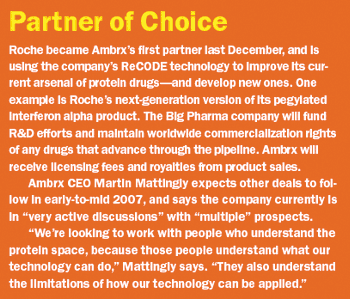
The ability to customize small molecules-to make them better, safer, and easier to use-has long been a staple of pharmaceutical development. But until recently, scientists had few options for enhancing biologics. San Diego-based Ambrx wants to change that.

When Arthur Higgins first announced that he was about to take the reins of the healthcare group at Bayer, in 2004, colleagues were surprised.

The problem isn't that there's conflict between safety and efficacy or between getting a useful medicine to market and protecting the public from a dangerous one. The problem is that the conflict isn't well structured. That needs to change.

Isr?l makov has adventure in his blood. A fourth-generation Isr?li, he speaks proudly of his great grandmother, who bought and sold wool in Russia until the late 1890s when, at the age of 50, she moved to Palestine, bought a piece of land, and helped found a town in the wilderness. It was the kind of career move that Makov, CEO of Teva Pharmaceuticals, admires and emulates. As a boy, he rode a donkey to work in his father's orchards on the land his great grandmother bought. He attended an agricultural boarding school, started his career in citrus exports and-decades before Teva recruited him-managed Abic, the second-largest pharma company in Isr?l, and founded Interpharm, the country's first biotech company.

i1-378057-1408682043673.jpg

With "launched the world's best-selling drug" on his resume, Rob Scott was ready for his next professional endeavour. The former Pfizer executive is now head of R&D and chief medical officer at AtheroGenics, named for the signature technology that's being used to develop AGI-1067, a cardiovascular anti-inflammatory in late Phase III clinical trials.

i1-369265-1408689235090.jpg

Just because outside contractors and vendors are experts does not mean everything will happen exactly the way you want it to. There's a lot of oversight.

What does it take to keep your employees on board? In the 1980s, employees looked for performance pay. In the 1990s, they wanted job security. Employees' needs have changed as society has, yet one thing has remained the same: Employees are always looking for something more out of their jobs. They want better quality of life at work.

In an article for the New York Times, reporter Damien Cave pointed out how few heroes have been publicly recognized by the Administration in the current war. Despite the fact that there have been incredible acts of heroism and gutsy leadership on the ground of this Iraq war, the powers that be, for the most part, are calling no attention to it-at least no prime-time attention. Damien's most damning example came from Major Bruce Norton, a military historian and author of Encyclopedia of American Military Heroes, who recounted how a Marine recently received his Navy Cross, the second-highest military honor-not with ceremony and honor, but in the mail.